How Utility Bill Automation is Changing the Multifamily Game
Find out how utility bill automation solutions improve productivity for multifamily properties and simplify utility management across the resident lifecycle.
Within multifamily utility management, resident utility billing is a highly complex process. Property teams are tasked with handling utility invoices, allocating charges, generating resident bills, and dealing with disputes. It can be difficult for onsite staff to dedicate the care and attention required for each resident billing task, especially if utility operations are managed entirely in-house. As a result of the risks associated with manual management, utility billing can drain Net Operating Income (NOI) and revenue. These financial “leaks” include risks like invoice errors, inaccurate calculations, missed recoupment opportunities, and unseen utility theft.
Luckily, modern tools simplify the end-to-end utility management process from resident move-in to move-out. Digital solutions automate key tasks such as invoice audits, Ratio Utility Billing System (RUBS) calculations, accurate resident bill generation, and more. That said, despite utility bill automation services readily available for operators, many property teams still process utilities manually. In fact, recent survey data from Zego’s Multifamily Revenue Operations Report shows that nearly 50% of property managers still handled utility operations manually in-house in 2025.
In this article, we’ll explore how utility bill automation transforms multifamily operations across the resident lifecycle from move-in to move out.
OPERATIONAL INSIGHTS
2026 Multifamily Revenue Operations Report
With survey data from over 600 property operators, this study analyzes how multifamily operators are managing their community operations and identifies key opportunities for improving your multifamily operational efficiency.
Two ways to automate the utility billing process at resident move-in
The way property submeters are structured impacts resident utility billing methodology. Multifamily businesses usually opt for individually submetered units or master submetering — where properties receive one property-wide invoice per utility. Individual submeters track consumption per unit, and residents are billed based on their direct usage. With master submetering, properties use a Ratio Utility Billing System (RUBS). RUBS properties leverage customized formulas to allocate usage and generate resident bills.
#1: Setting up utilities and initial resident billing
Before: Traditionally, at resident move-in and throughout tenancy, property managers manually downloaded utility bills and shared them with their third-party billing vendor. This time-consuming process increases the risk of human error and can delay the resident billing process.
After: Automatic bill retrieval ensures that invoices are pulled securely and immediately, allowing property managers to process resident billing faster and more accurately. With a secure automated data feed, this not only saves property management staff time, it also decreases the risk for human error and shaves time off of the entire process, resulting in quicker resident billing and payback for the property.
#2: Identifying uncovered utility charges
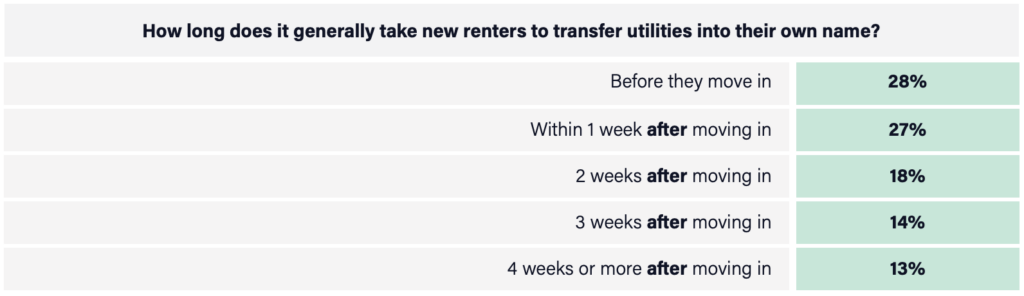
Before: When a resident does not transfer utilities under their name by required deadlines after move-in, properties often pay for that unit’s utility usage until the uncovered charges are discovered. Zego recently found that it takes 45% of renters two or more weeks to transfer utilities into their name according to property managers surveyed.
In order to catch utility transfer violations, onsite teams without digital tools must manually track usage from occupied units after every move-in. Often, staff rely on outdated spreadsheets or inefficient systems to capture this information. Doing this can lead to inefficiencies such as missed utility shutoffs or delays in setting up new resident accounts.
After: Property managers can utilize vacant unit cost recovery (VCR) services that automatically detect when residents fail to transfer utility accounts into their name within required timeframes. Vacant cost recovery solutions match occupancy data with consumption to ensure that residents are paying for their own utility usage. Additionally, VCR services can assist with administering VCR fees. These fees act as penalties for residents that fail to transfer utilities into their name by certain deadlines. This enables property managers to recoup some of the costs associated by utility theft while encouraging residents to transfer utilities on time. Automated VCR solutions allow properties to prevent utility theft, quickly resolve discrepancies, and minimize risk of lost dollars to uncovered consumption.
Three ways to automate the utility billing process during the lease
#1: Receiving and reviewing utility prebills
Before: In the manual world, managers receive the resident pre-bills for review in an Excel spreadsheet. They need to sort through it to confirm completion and accuracy before approval for billing. This manual intervention means more time wasted and more chance for errors.
After: Modern solutions allow managers to receive their prebills via a simple automated file which can be quickly reviewed and approved. Painless prebill services also do the work of highlighting common exceptions as prebills come in, allowing property teams to review, filter, and make adjustments easily before final bills are generated. This eliminates the risk of errors associated with manual reconciliation, promoting accuracy and efficiency at the start of the resident billing process.
#2: Reconciling utility bill payments
Before: Once utility bills have been sent to residents, property managers are in the throes of payment collection and reconciliation. Sorting through checks and money orders is a tedious process when done manually. Even after accepting payments from renters, operators are tasked with reconciling payments with their accounting software and balancing rent and utility ledgers.
After: With digital payment solutions, residents can choose to pay online or have their paper payment converted digitally, eliminating the risk of theft and fraud associated with checks and money orders. Auto-payment solutions can integrate with a property’s accounting software, saving loads of time for staff, eliminating the need for manual reconciliation and reducing the risk of human error.
#3: Reporting and benchmarking multifamily utility data
Before: Benchmarking usage data is a critical step in multifamily utility management. This allows property managers to keep track of consumption trends over time, identify uncommon usage, and pinpoint opportunities for recoupment or cost savings. Unfortunately, in-house management can result in neglected utility reporting. Traditionally, property teams manually populated spreadsheets or logbooks using costs and usage allocations from statements. This creates hours of additional care and attention that some onsite teams simply don’t have the bandwidth for.
After: A robust utility expense management platform collects data from invoices and bills and automatically records those transactions in your accounting software. Utility intelligence solutions then monitor those numbers over time, identifying trends in usage that may be of interest to property teams. Automated tools can notify operators of anomalies that can stem from faulty meters or leaky appliances. These tools take hours of manual tasks off onsite teams, offer portfolio-wide data visibility to operators, and promote smart decision-making with accurate reports.
One way to automate the utility billing process at resident move-out
#1: Generating final utility charges
Before: When a resident moves out, the property manager must determine any final utility charges that need to be billed. During move-outs, resident utility billing can be particularly difficult to prorate before supplier invoices have been received. This responsibility requires careful calculation in order to avoid final disputes and resident dissatisfaction.
After: Automated move-out calculators can equitably and accurately calculate final utility balances for property teams that use a Ratio Utility Billing System (RUBS). With formulas customized to your property, move-out calculators leverage property-wide usage data and custom criteria to generate final charges for residents. These tools simplify what is traditionally a time-intensive process during hectic times such as move-outs.
Automate your utility bill process
Automating the utility billing, payments and reconciliation process results in measurable time returned to property managers that can be spent on attracting and retaining residents or other more valuable projects.