4 reasons multifamily properties should charge resident utilities based on usage
Learn why multifamily properties that charge resident utilities based on usage enjoy higher cost recovery and better recoupment.
Property managers can charge resident utilities through a few different methods. The most common ways are: charging a flat fee monthly rate, including utilities in rent (which can also be a flat fee), and consumption or usage-based billing. If you’re a multifamily property that charges residents for their share of utility usage, you’re already recouping some of your expenses and are one step ahead of the game. But if you manage this process in-house, include utilities in rent, or charge residents a flat fee rate, you might want to refresh your utility strategy.
Four reasons why property managers should charge utilities based on usage
Utilities are a consistent top-three operational expense for multifamily properties. The way property teams manage utilities has a major impact on Net Operating Income (NOI) and revenue. That said, in a price-sensitive market with fluctuating utility costs, it is essential to manage utilities cost-effectively — otherwise, revenue can quickly slip through the cracks. Maximizing cost recovery and recouping utility charges from residents is a crucial step in effective utility management.
Unfortunately, many property managers still engage in ineffective utility billing practices. Zego’s Multifamily Revenue Operations Report found that, out of 600+ multifamily professionals surveyed in 2026, nearly half included utilities in rent or charged a flat monthly rate. These findings show that many property managers have yet to embrace reliable, cost-saving usage-based utility processes.
#1: Charging flat fees leave properties vulnerable to shifting utility rates
Flat fees are often determined based on historical utility data used to forecast and solidify utility charges going forward. The problem with this method is that utility rates are fluid. Charging residents a flat fee rate leaves your cash flow volatile as rates fluctuate, and leaves money on the table as rates rise.
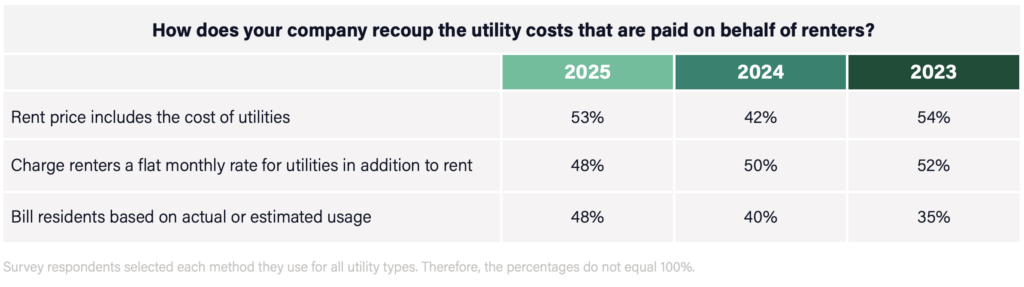
Out of 608 multifamily professionals surveyed, 48% of respondents charged renters a flat monthly fee for utilities in 2025. That means that 48% of property manager respondents are highly likely to have under- or over-charged for seasonal utility consumption. Under-charging for utilities results in lost dollars as properties absorb the difference between resident usage and invoice charges. On the flip side, over-charging utilities can result in regulatory violations and penalties for non-compliance.
#2: Including utilities in rent restricts revenue and cash flow
Over 50% of property managers surveyed chose to include utilities as part of the rent price in 2025. This may be because including utilities in rent can seem like a strategic incentive to attract renters, or because calculating utilities seems simpler when absorbed into rent. However, this practice can actually put properties at a competitive disadvantage by artificially inflating rent prices. Rent seems higher to residents, and the only way to adjust utility charges is to adjust the overall rent itself. Considering that “rent is too expensive” is the top reason that residents choose not to renew a lease, offering rent-included utilities can hurt revenue through non-renewals.
#3: Unrecovered utility charges drain dollars and drive up property costs
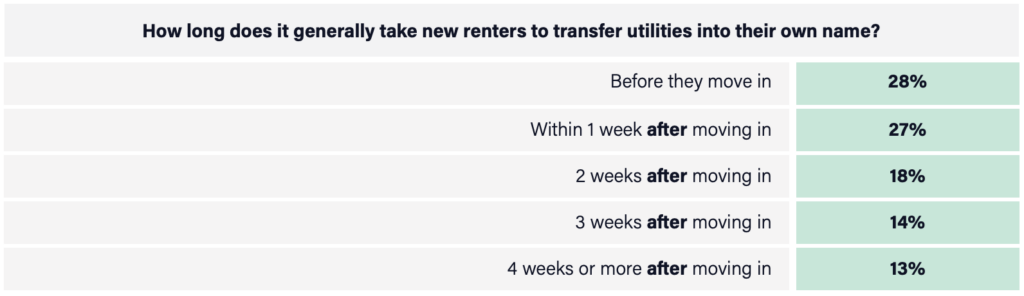
Utility transfer violations happen when a resident fails to transfer utilities into their name in a timely manner after move-in. When this happens, properties absorb that unit’s utility costs until the violation is discovered. This is a common occurrence, with property managers reporting that 45% of residents take 2 or more weeks to transfer utilities into their name.
The impact this can have on property costs is significant. On average, we found that dollars lost to utility transfer violations stack up to $40,000 in annual costs for multifamily properties of all unit sizes. Fortunately, vacant cost recovery services exist to help busy property teams monitor and recoup utility charges during vacancy periods. This can be done by matching unit usage to occupancy data, proving that monitoring and charging based on consumption is vital towards protecting property NOI.
#4: How to help simplify complex utility operations for multifamily property teams?
One of the main reasons property managers likely choose utilities-included rent or charge a flat monthly rate is resource strain. The end-to-end utility management process is tedious, from auditing invoices to generating bills. It can seem far easier to calculate a recurring flat fee, especially when utilities are managed in-house. Luckily, modern solutions and billing partners are more accessible today than ever. Digital tools and dedicated teams can assist properties with tracking usage, allocating charges, and recouping utility costs from residents. Despite this, property teams still largely manage their usage-based utility operations in house — though third-party outsourcing has grown from 8% to 19% since 2023.

While more and more owners and operators turn to third party billing solutions, we found that 33% of property managers still manage utility billing in-house. Operators can save much more staff time and cut operational costs by implementing automated tools into their utility routines.
Simplify usage-based utility billing with modern solutions
Learn how Zego Utility helps property teams accurately track, allocate, and recoup expenses by booking a free utility assessment.